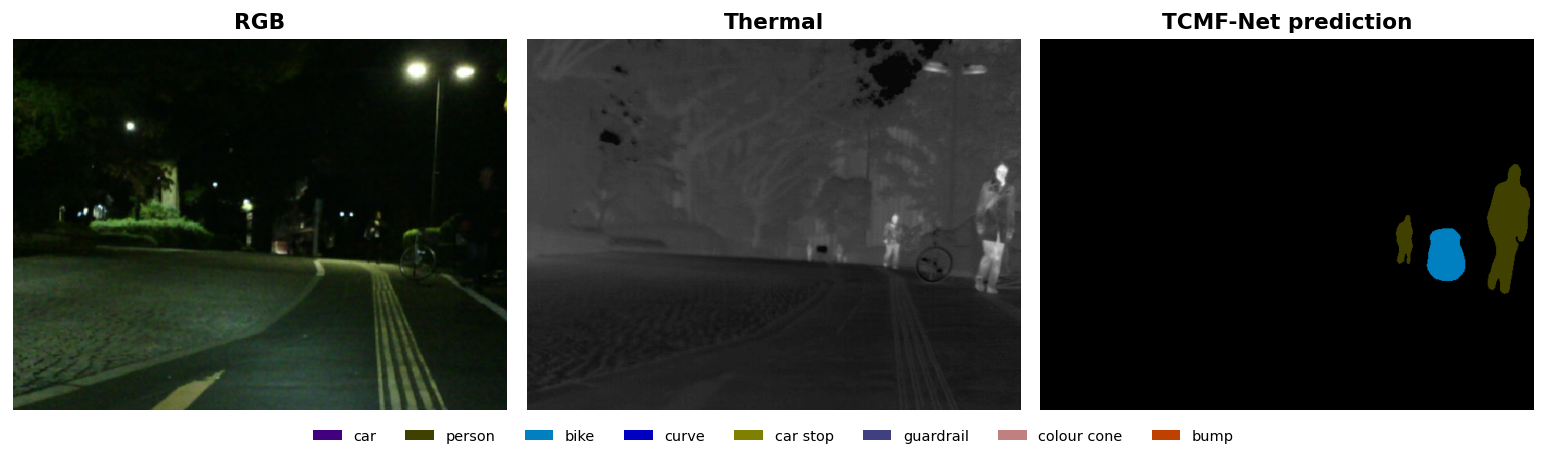
Edge vision systems must fuse complementary imaging modalities under tight compute budgets while staying interpretable. We present TCMF-Net, a Transformer-guided Cross-Modal Fusion Network that pairs a shared-weight pyramid-Transformer encoder, a deformable cross-modal attention (DCAF) module for implicit cross-modal registration, and a modality-aware gate for adaptive weighting. The entire study is fully reproducible on a single 6 GB laptop GPU: it outperforms classical fusion baselines on TNO, RoadScene and MFNet, generalises zero-shot, extends to segmentation, distils to a 0.048 M-parameter student, and produces explanations that are quantitatively faithful.
Learns 2-D sampling offsets to register modalities implicitly. In the ablation it is the single biggest driver of mutual-information gain.
Occlusion-based modality contribution, a learned gate, and attribution faithfulness that measurably beats a random baseline.
5.25 M parameters, 73 FPS at 256² on an RTX 4050; distilled to a 0.048 M student above 1000 FPS.
Released code, splits and seeds. Every number regenerates with one command, with no fabricated results.
Two source images flow through one shared pyramid-Transformer encoder. Deformable cross-modal attention and a per-pixel gate fuse them, and a U-Net decoder produces the fused image together with an optional segmentation map.
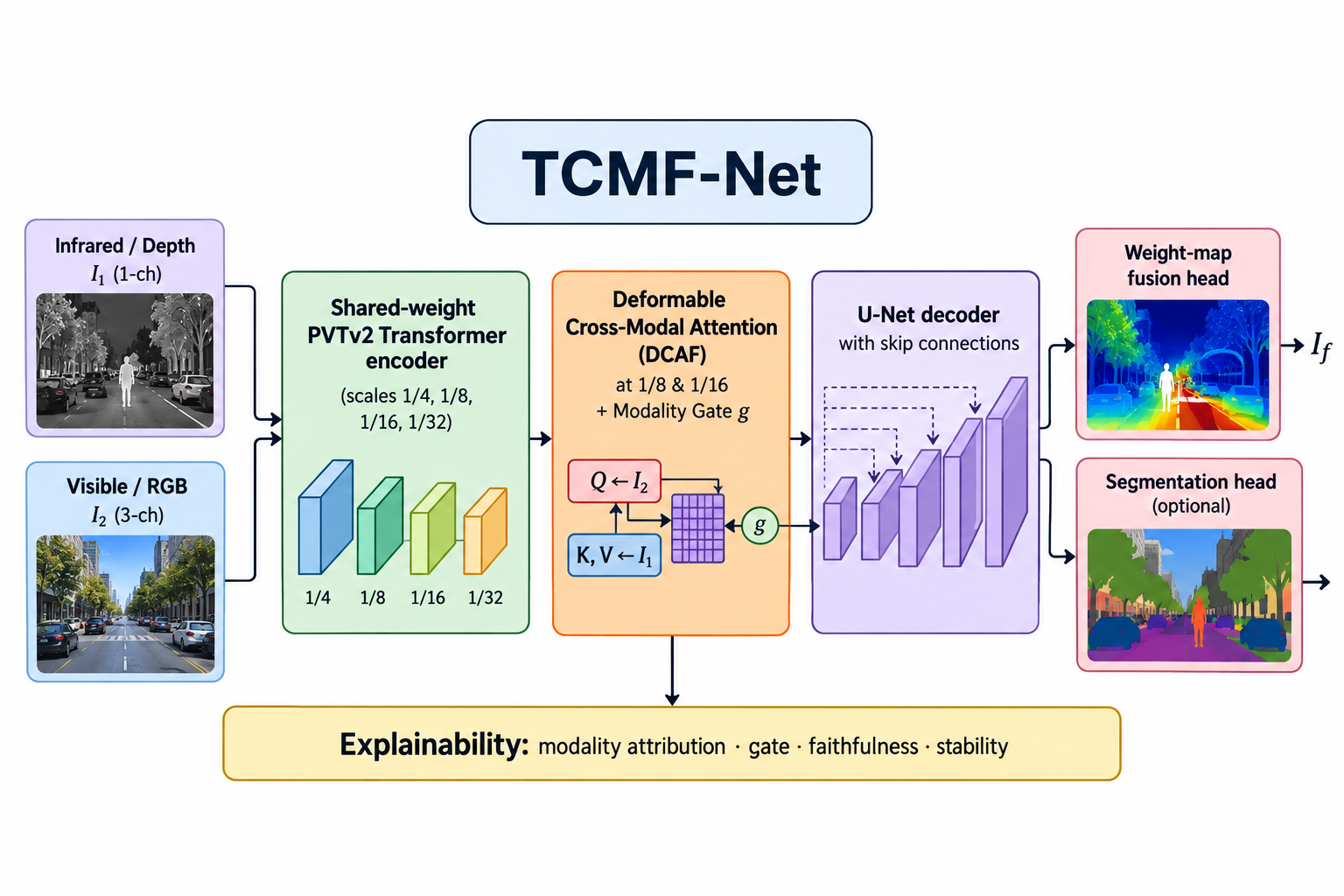
PVTv2 pyramid Transformer, four scales, one set of weights for both modalities.
Deformable cross-modal attention at 1/8 and 1/16. Query is visible, key and value are infrared.
A per-pixel, per-channel gate decides how much of each stream to trust.
A full-resolution weight-map head preserves input-level sharpness.
Under one identical protocol, TCMF-Net outperforms classical baselines on the information- and gradient-oriented metrics across all three benchmarks (MFNet is evaluated zero-shot). Select a metric and a dataset:
Higher is better. A lower SSIM for TCMF-Net is expected, because selective fusion deliberately departs from each single source in order to combine both.
Removing DCAF drops mutual information the most. The gate is near-neutral on these aggregate metrics, which we report honestly.
Best per metric and dataset in bold. TCMF-Net, Average and Laplacian pyramid are all run under one identical protocol with a single shared metric implementation.
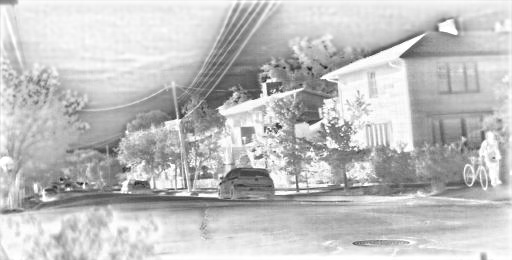
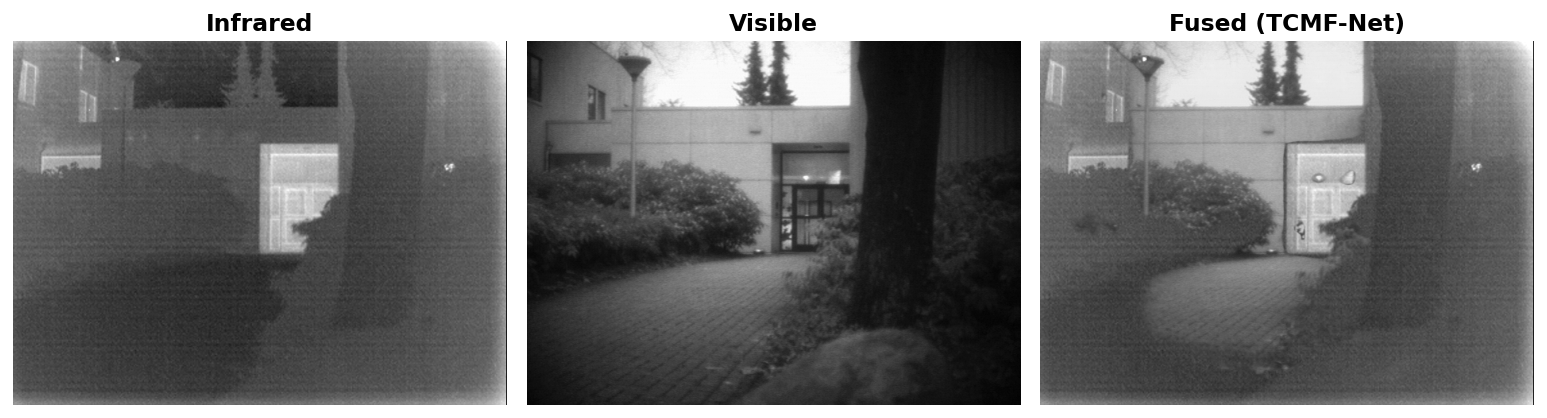
Real outputs from the released model. Drag the slider to reveal the fused result over the visible input.

Interpretability is built in, not bolted on. Three complementary lenses reveal which sensor drove a decision and whether the explanation can be trusted.
Occlusion attribution: replace one modality with its mean and measure how much the fused output changes.
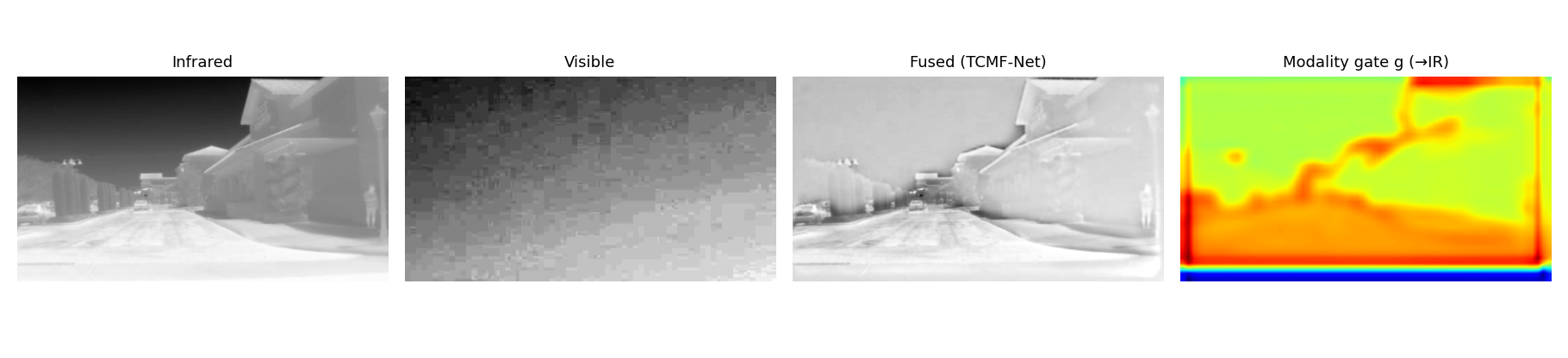
The per-pixel gate g, read straight from the network, shows its modality preference at every location.
Deletion and insertion curves against a random baseline, plus robustness of attributions to input noise.
Infrared contributes 71% on thermal-rich driving scenes but only 48% on TNO. The fusion adapts to the scene rather than fixing a ratio, matching the intuition that thermal cues matter most at night.
Mean change in the gate under Gaussian noise (σ = 0.02) on a [0,1] scale. Lower is more stable: the attributions barely move, so they are not artefacts of input noise.

Distillation retention: EN 97%, SSIM 102%, MI 117%, QAB/F 88%. Most of the quality is kept at 109× fewer parameters. Pretrained weights (teacher, distilled student, ONNX and INT8) are in the weights folder.
@incollection{bhadaurya2026tcmfnet,
title = {Explainable Transformer-Based Multimodal Image Fusion for Edge Vision Systems},
author = {Bhadaurya, Vatsalya},
booktitle = {Handbook of Deep Learning Methods for Digital Image Processing},
publisher = {CRC Press, Taylor and Francis Group},
year = {2026},
note = {Project page: https://tcmf-net.vatsalyaaa.me/ , Code: https://github.com/VatsalyaBhadaurya/TCMF-Net}
}